

Our research team is currently focused on developing highly efficient assays for the selective purification of SARS-CoV-2 and Hepatitis viruses using oligo-coated magnetic nanoparticles. This innovative approach employs magnetic nanoparticles coated with oligonucleotides, specifically targeting genetic sequences unique to these viruses.
In the fight against infectious diseases, rapid and accurate diagnosis is essential for effective disease prevention
By exploiting the magnetic properties of the nanoparticles, we can isolate and purify the viral particles from complex biological samples. Our approach has several advantages over traditional viral purification techniques, including increased sensitivity, speed, and specificity. Moreover, it can be easily adapted for high-throughput extensive sample-size screening, making it an ideal tool for epidemiological studies and clinical diagnostics.
Our assays are based on synthetic oligos that are coated onto magnetic nanoparticles. These nanoparticles are then used to selectively purify viral particles from a sample, allowing for highly accurate and sensitive detection. In addition, using magnetic nanoparticles has several advantages, including their high surface area-to-volume ratio and ease of use in high-throughput settings.
In order to further assess the analytical sensitivity of our assays, we conducted a series of experiments in controlled laboratory settings. The objective of these experiments was to determine the Limit of Detection (LOD) of our assay, which refers to the lowest concentration of viral particles that can be reliably detected and quantified. To achieve this, we utilized different viral control samples at varying concentrations and monitored the CT values generated by our assays.
We were able to determine the LOD of our assays for SARS-CoV-2 and Hepatitis viruses. Assays were highly sensitive and could reliably detect viral particles at very low concentrations such as 10-100 copies of viral genetic material (Fig 1, Fig 2).
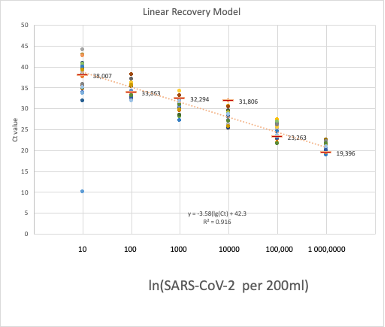 | |
| Fig 1. Linear Recovery Model SARS- CoV-2 | Fig 2. Linear Recovery Model Hepatitis Virus (HCV) |
Overall, our experiments demonstrate the high analytical sensitivity and specificity of our assays for the selective purification and quantification of SARS-CoV-2 and Hepatitis viruses. These findings have significant implications for the development of more accurate and efficient diagnostic tools for the detection and monitoring of viral infections.
Looking ahead, we are planning to broaden our research portfolio and include other important pathogens. By continuing to develop and refine assays focusing on analytical sensitivity and selectivity, we hope to contribute to developing diagnostic tools that can improve global health outcomesP


